Mitsubishi Electric has developed an edge digital twin system for CNC machine tools that reduces errors caused by part deformation under cutting force by up to 50 percent. The company disclosed the technology March 25, 2026, after a three-year joint research program with RWTH Aachen University in Germany.
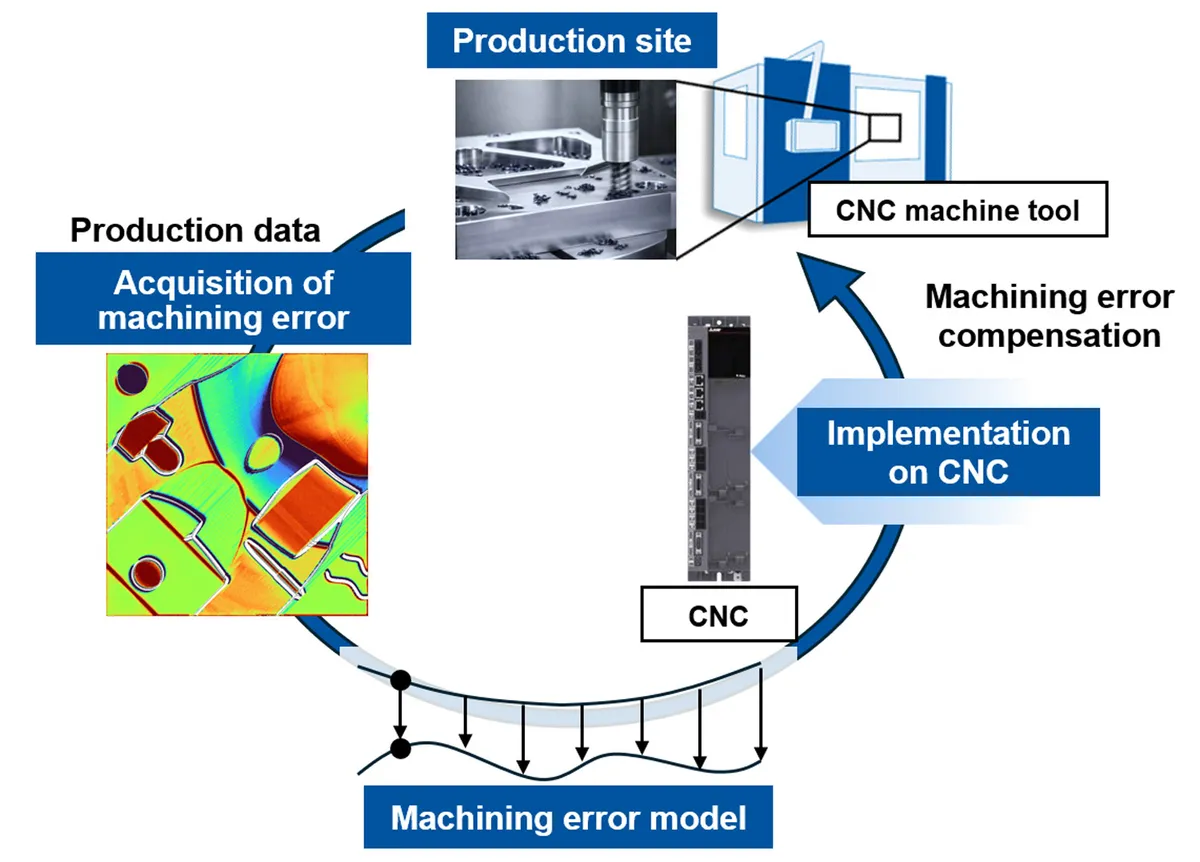
The system runs a proprietary physical model on a high-speed edge computing unit co-located with the CNC controller. That model is built from a reduced-order equation set trained on large volumes of machine operational data, including axis positions, motor currents, and cutting forces. Sensors feed the model at high frequency, and only the signals relevant to estimating current machining error are extracted. The estimated error returns to the CNC control system as a real-time compensation signal.
Engineers machining compliant workpieces to tight tolerances will recognize the underlying problem: a cutting tool applying lateral force deforms the part slightly, producing dimensional error that post-process inspection catches only after the damage is done. What's new here is a model compact enough to run on the machine controller itself, closing the correction loop inside the machining cycle without any cloud dependency or added latency.
Real-time testing on a CNC machine tool equipped with a Mitsubishi Electric CNC device at RWTH Aachen University confirmed the 50 percent error reduction. Fewer defective parts and more consistent surface quality are the direct outcomes, along with a reduction in material waste from scrapped components.
The joint research program ran from April 2023 to March 2026. No commercial release timeline or product designation accompanied the announcement. The disclosure fits a broader push among CNC suppliers to move dimensional assurance upstream, embedding correction at the point of cut rather than depending on measurement after the fact.